The One-Voice Myth in a Family Story
The one-voice myth in a family story can flatten real memories; learn how to retell a shared event through distinct voices without forcing agreement.
How do you retell a family story when the people who were there remember it differently? The one-voice myth in a family story turns a shared event into a single polished performance, often by giving one narrator every line. A chorus, a rotating storyteller, or a deliberate shift between voices can keep the tale moving without pretending everyone remembers it alike.
Give voices distinct work
A retelling is not a transcript. It selects details, shapes a sequence, and decides who speaks. The useful question is not how to preserve every disagreement, but how to make each voice contribute something the others cannot.
One teller might carry the main sequence while others interrupt with a remembered sound, gesture, or phrase. In an oral performance, a second person can repeat a line in a different tone; in print, a short refrain or a change in speaker can signal that the story has shifted. These choices make difference part of the form rather than a footnote attached to it.
Choose a story structure
Several familiar structures can hold a group retelling:
- Relay: Each teller takes the next moment in the sequence. Use it when participants can agree on the broad order; if the handoffs become confusing, add a recurring phrase to mark each turn.
- Chorus: A group repeats a line that expresses a shared refrain. If the wording does not feel true to everyone, let a smaller willing group speak it or replace it with a neutral sound or gesture.
- Call and response: One voice offers a prompt and another answers with a different recollection. If the exchange starts to sound like a contest, separate the voices into distinct passages instead.
- Braided versions: The story moves between tellers, returning to the same moment from different angles. If listeners lose track of who is speaking, name each voice at the start of its section.
- Frame story: A present-day gathering introduces memories told within it. If the framing scene implies that every teller has reconciled, remove that implication or let the ending remain unsettled.
- Rotating narrator: The speaker changes at planned points. If a transition makes one person appear to endorse another’s account, mark the change with a name, pause, or visible section break.
These are artistic options, not obligations. A plain sequence with two clearly marked voices may serve a family better than an elaborate performance that asks people to act out feelings they did not express.
Shape the disagreement
Difference can live in timing, emphasis, or what a teller notices. One person may remember the hush before a departure; another may remember the radio playing. A retelling can place those details side by side without turning either one into the official atmosphere of the scene.
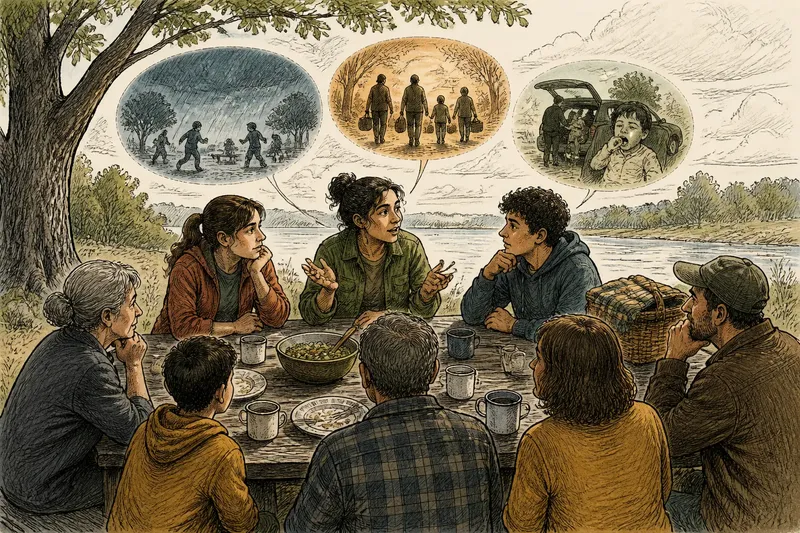
Say you are preparing a short spoken piece about a family picnic, using invented details for this example. Your starting notes say that the group left the park before dusk, one cousin remembers a sudden rain shower, and another remembers packing up because the youngest child was tired. First, make “the family left the park” the shared action. Next, give each cousin a separate line for the reason they remember. Then read the passage aloud: if the order makes one account sound like a correction, swap the lines or introduce them as parallel memories. The resulting version shares the departure while leaving its cause open.
Not every difference belongs in the finished story. If a disputed detail has no bearing on character, mood, or consequence, leaving it out is often kinder and clearer than building a scene around it.
Set rehearsal boundaries
Before a reading or performance, agree on what may be changed and what should stay in each teller’s own words. A facilitator can invite people to mark a line as theirs, as a paraphrase, or as something they prefer not to perform. That distinction gives editors room to shape the piece without making a participant responsible for a sentence they did not choose.
Decide in advance whether listeners may ask questions, whether the piece will be recorded, and where a recording could be shared. If a story touches on harm, private relationships, or an unresolved conflict, do not turn participation into a public test of loyalty. A qualified counselor may help if the group needs support discussing painful experiences.
Questions about group retellings?
How many voices should a retelling use?
Use as many as listeners can follow and participants genuinely want to contribute. If several accounts repeat the same point, combine them only with permission or let one voice carry that part.
Can a narrator speak for someone else?
A narrator can paraphrase another person’s account when that person has agreed to the wording and context. If permission is absent or the subject is sensitive, omit the passage or keep it clearly identified as secondhand rather than performing it in that person’s voice.
What should the group do when no ending is shared?
End with an agreed action, image, or unanswered question rather than inventing consensus. A pause, a change of speaker, or a return to the opening line can give the performance shape without claiming that everyone reached the same conclusion.
How can a story work for listeners unfamiliar with the family?
Give each speaker a brief identifying cue and enough context to understand the event. Avoid a long cast introduction; a name paired with a role in the moment is often easier to follow than a list of family relationships.
Leave a useful trace
For a live retelling, a simple cue sheet can list the speaking order, each person’s opening words, and any agreed pause or refrain. For a printed version, paragraph breaks and speaker names can do the same work. Keep the structure visible enough that a future teller can recreate it without being asked to settle the memories behind it.
The one-voice myth in a family story weakens when the form makes room for more than one storyteller, not when every difference is explained away. Before sharing, listen for places where a chorus, narrator, or closing line claims agreement that the group did not give. A small change in who speaks next can preserve both the story’s shape and the space for another voice.