A Story Night That Leaves Room for Quiet Voices
Plan a story night with clear turns, an optional prompt, and a pass option so quieter guests can join on their own terms without competing to speak.
How do you plan a story night that feels welcoming to guests who may not want to speak? A story night for quiet voices can begin with a low-pressure prompt, a comfortable room, and the freedom to take part by listening. The host’s choices before the gathering often matter more than any formal activity during it.
A welcoming invitation
A useful invitation tells guests what kind of gathering to expect without demanding a particular kind of story. Say that people may bring a memory, a fragment, or simply listen; avoid language that suggests everyone must entertain the group or disclose something personal.
Choose a prompt with room to wander. “Share a place that stays with you, or choose another subject” offers a starting point while leaving a guest free to talk about a bus ride, a library, or nothing at all. A narrow prompt can make people hunt for the right answer, while an entirely open invitation may leave them unsure where to begin.
It also helps to say what the evening is not: a critique session, a contest, or a round of advice-giving. Guests can decide how much to share when they know a story will not automatically become a topic for group analysis.
Room and materials
Arrange chairs so people can hear one another without having to sit under a spotlight. A living room, community room, or library meeting space can work; leave a clear path to the door and place water where guests can reach it without interrupting someone.
Keep materials simple. A card with the prompt and a few shared agreements may be enough. A basket of folded prompts can help guests who prefer choosing a subject privately, but elaborate decorations, printed decks, and a timer are not worth the effort unless they suit the group’s own habits.
Before guests arrive, decide how you will respond to a pass, a long pause, or a story that touches on something sensitive. The point is not to script every moment. It is to avoid improvising a response that pressures someone who has already made a choice.
Agreements that protect choice
Keep the group’s agreements short enough to remember. For example:
- Check whether each person can hear the speaker; if not, then adjust the seating, or ask the speaker to choose a more comfortable position.
- Check that guests understand passing is allowed without explanation; if someone seems unsure, then restate the option generally, or move on without asking them to justify a choice.
- Check whether listeners know when comments are welcome; if not, then agree to hold questions until the speaker invites them, or let the speaker finish without opening discussion.
- Check whether the prompt feels optional; if a guest treats it as a required subject, then repeat that another subject is fine, or offer the choice to listen.
- Check whether anyone is being singled out after passing; if so, then redirect attention to the gathering as a whole, or quietly stop the follow-up questions.
- Check whether the room feels exposed or uncomfortable; if a guest signals discomfort, then offer a quieter seat or a break, or let them leave without making an announcement.
These agreements do not dictate what a good story sounds like. A short memory, an unfinished thought, and a decision to listen can all fit the gathering.
A worked evening
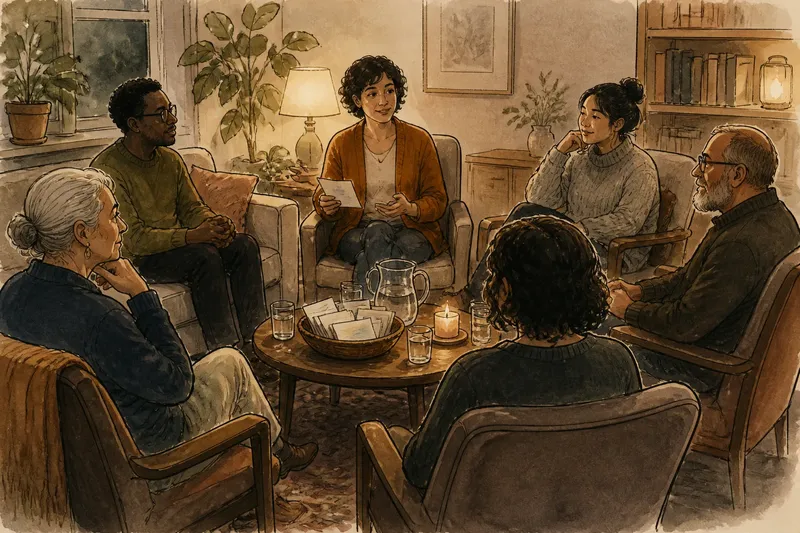
Imagine six neighbors meeting in a living room after a garden workday. The host, Mara, has a card with the prompt “Tell about a place where you felt welcome, or choose another subject,” plus a reminder that passing is fine and questions wait until invited. She wants to avoid turning the evening into a sequence of speeches.
Mara begins with a brief memory about waiting for a friend on a bakery bench, then gives the group time to settle. One neighbor talks about a gate that stuck after rain. When another guest starts to respond, Mara says, “Let’s keep listening until this person is done; there’ll be room to talk afterward.” The speaker finishes without having to compete for attention.
A new guest passes. Mara acknowledges it and continues, rather than asking whether the guest is sure. Later, she offers the whole group a chance to add a thought or keep listening. The guest chooses to share a short memory of waiting in a public library during a storm. The prompt has opened a route into a story without requiring a connection to the garden.
At the end, Mara asks whether anyone wants to leave a final thought, making clear that no one needs to answer. A few guests speak; others do not. The observable result is a gathering in which the new guest has been able to choose when to contribute, while the group has not treated silence as a problem to fix.
Questions about quiet voices?
What if a guest passes more than once?
Accept the choice and continue without asking for a reason. If the guest wants another way to participate, they can ask; repeated passing does not require the host to intervene.
Should stories have a time limit?
A shared sense of brevity can help a gathering stay attentive, but a strict timer may make personal memories feel like performances. The host can model a concise story and allow speakers to finish when their thought feels complete.
Can guests bring their own prompts?
Yes, if guests may decline any prompt without explanation. Let someone choose a prompt, use the group’s original invitation, or speak without one.
How should a host handle silence?
Allow a pause without treating it as a failure. If nobody chooses to speak, the host can move to another part of the evening or offer a fresh, optional prompt instead of repeatedly asking for a response.
After the stories
Close without requiring a recap or a round of praise. You might thank guests for the care they gave the gathering, then let conversation return to its ordinary pace. If people want to discuss a story, invite them to ask its teller whether that conversation is welcome.
For a story night with quiet voices, the central planning question is not how to make everyone talk. It is whether guests can understand their choices before they are put on the spot. A clear invitation and a respectful response to silence can give each person room to decide what participation means for them.