Before the Scrapbook: How Families Kept Shared Stories
A family scrapbook gathers photographs and keepsakes into a usable record, helping relatives contribute in different ways while keeping the objects’ context close.
Which family stories can a scrapbook hold when people bring different kinds of memories to the table? A family scrapbook gives photographs and keepsakes a place beside the small acts that make them legible: naming, arranging, annotating, and deciding what should remain private.
That work is less about settling on a single version of the past than choosing how the group will handle its materials. A page can show what an object is, who supplied it, and what remains unknown, without turning every disagreement into a contest over the definitive account.
Objects shape the page
A photograph, recipe card, postcard, or concert program can prompt a story without asking anyone to write a polished narrative. A recipe might sit beside a note about who copied it; a postcard can carry the place name and the sender’s handwriting. The object gives the page a focus, while a short caption supplies context.
Different materials call for different handling. A bound scrapbook creates a fixed sequence, while a ring binder lets contributors move pages as the collection grows. A shared digital album makes remote additions easier, but it needs clear captions and a plan for preserving original image files.
It is not worth making every page match. Decorative lettering and coordinated paper can consume the time needed to ask where an item came from. Legible notes and a visible connection between an object and its story do more for future readers.
Arrange without forcing a plot
A scrapbook can follow a family line, a place, a recurring gathering, or the order in which objects surfaced. None of these arrangements has to imply that the family’s story unfolded neatly. A page organized around a kitchen, for instance, can bring together a recipe, a photograph, and a note about a meal without pretending they document the same occasion.
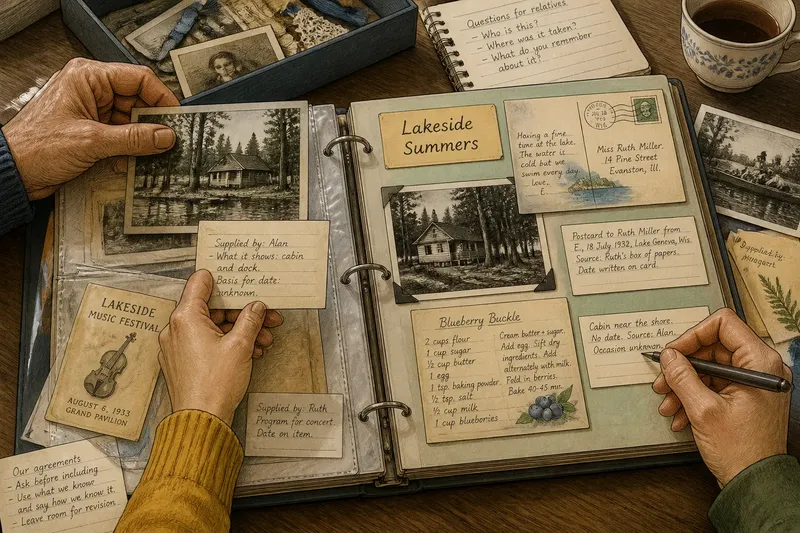
Say a family has a postcard, a cabin snapshot, and a handwritten recipe, with no proof that they belong to one trip. The editor places them on separate pages under the shared heading “Lakeside summers,” labels the postcard’s known destination, and leaves the photograph’s occasion unspecified. The result groups related material while avoiding a claim the objects cannot support.
A small card beside each item can record who supplied it, what it depicts, and the basis for any date or identification. If a detail comes from recollection rather than a marking on the object, say so. That distinction lets later readers understand why the caption says what it says.
Make contributions easy
Not every contributor will want to write. Someone can choose a photograph, point out a person, or dictate a caption for another person to write down. Before adding dictated wording, read it back and ask whether the speaker wants any changes.
Keep the invitation specific: ask for a name, a place, or what an object brings to mind, rather than requesting a complete family history. Contributors can pass on a question or decline to include something. A shared archive works better when participation does not require a public performance.
- Check whether the item’s owner has agreed to include it; if yes, add it with the agreed context, and if not, leave it out or ask about a private copy.
- Check whether names and relationships are known; if yes, write the source of that identification, and if not, use an uncertain label rather than guessing.
- Check whether a date is written on the item or recalled by someone; if written, record it as marked, and if recalled, attribute it or leave the date open.
- Check whether a scan preserves the original image; if it does, keep that file unchanged, and if it does not, rescan before adding edits or captions.
- Check whether a page groups items by a documented connection; if it does, state that connection, and if not, use a broad theme or keep the items separate.
- Check whether a caption can be read and understood without the contributor present; if it can, keep it, and if not, ask for clearer wording or add a brief explanation.
Choose a workable format
A ring binder is useful when pages may need to move or be removed. Sleeves can hold delicate papers without requiring adhesive, while plain, acid-free paper gives captions room to breathe. For any item whose condition or preservation needs are uncertain, ask a qualified archivist or conservator before attaching or handling it extensively.
A digital scrapbook can use a shared folder or photo album with captions and contributor names. Keep an unedited copy of each scan apart from cropped or annotated versions so that a correction does not replace the source. A printed page can carry a note pointing to a digital file when a recording or longer account belongs with the image.
Privacy deserves a decision of its own. Ask before including personal letters, images of people who have not agreed to wider circulation, or accounts that reveal sensitive details. A family can keep a restricted version for relatives and omit material from copies meant for broader sharing.
Which scrapbook choices fit?
How can relatives who dislike writing contribute?
Invite them to select an object or dictate a short caption, then read the wording back for approval. This keeps the contribution in their voice without making handwriting the price of taking part.
What belongs in a caption?
Record what the item shows, who supplied it, and what is known about its place or occasion. Mark remembered details as recollections, and leave gaps open rather than filling them with a plausible guess.
How should a growing collection be arranged?
Use a binder or digital album if pages and files will need rearranging. A bound volume can suit a settled sequence, but it is less convenient when new material may change the order.
What if an item should stay private?
Leave it out of shared copies or keep it in a restricted section with the owner’s agreement. If the family cannot agree on access, do not circulate the item while that question remains unresolved.
Leave room for revision
A scrapbook becomes more useful when its captions can be corrected without silently erasing how an earlier page was understood. Keep original scans, date revised captions when appropriate, and make additions easy to distinguish from the material they clarify.
For a family scrapbook, that modest record of changes is part of the story, not clerical debris. It shows how a group learned to describe an object, and gives the next contributor a clear place to begin.